





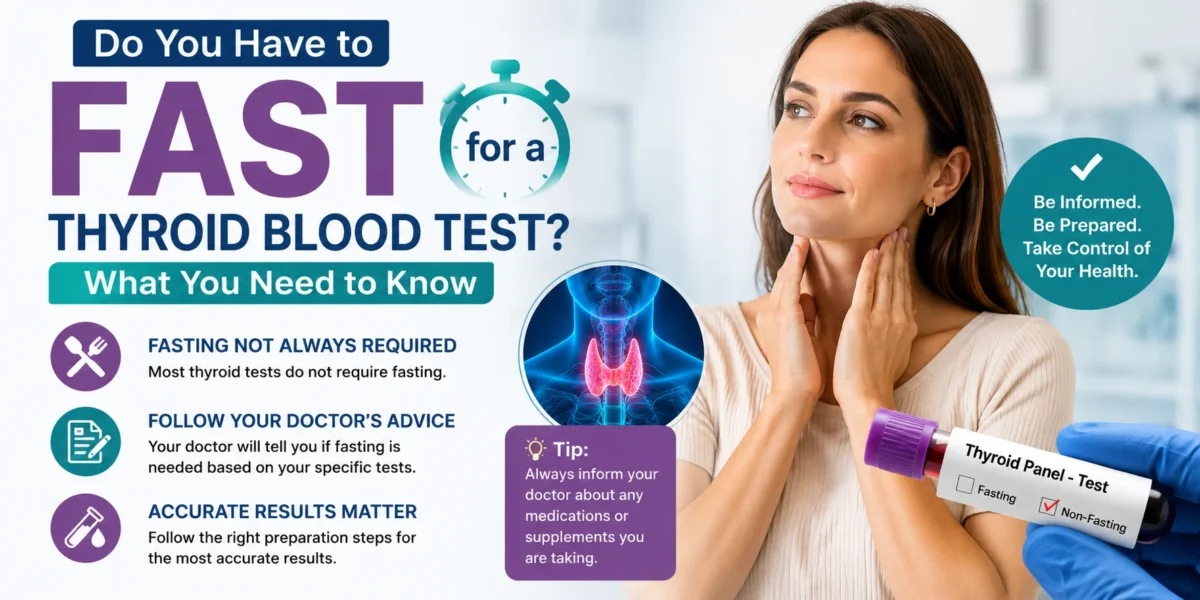
If your doctor has just ordered a thyroid blood test, the first question that probably came to your mind is: Do I need to fast for this? It is a completely valid concern — especially when you have been told to skip breakfast for other lab tests in the past. The short answer? It depends on what is being tested. But as with most things in medicine, the full picture is a little more nuanced.
Thyroid disorders affect an estimated 200 million people worldwide, with many millions more going undiagnosed. From unexplained weight gain to chronic fatigue, hair loss, and mood changes — the thyroid gland sits at the center of some of the most common health complaints people bring to their doctors. Getting tested is the first step, but knowing how to prepare for the test ensures you actually get accurate results.
What Is a Thyroid Blood Test?
A thyroid blood test measures the levels of hormones and related markers in your blood to assess how well your thyroid gland is functioning. The thyroid is a butterfly-shaped gland in your neck that produces hormones regulating metabolism, energy, mood, heart rate, body temperature, and dozens of other critical processes.
The most commonly ordered thyroid tests include:
- TSH (Thyroid-Stimulating Hormone): Produced by the pituitary gland, TSH tells the thyroid to release hormones. It is the most sensitive and widely used marker for thyroid function.
- Free T4 (FT4 / Thyroxine): The primary hormone produced by the thyroid. Most T4 is bound to proteins, but the “free” portion is biologically active.
- Free T3 (FT3 / Triiodothyronine): The more active form of thyroid hormone. It is often ordered when T4 is abnormal or when conversion issues are suspected.
- Total T3 and Total T4: Measures both bound and free hormone; less commonly used today.
- Thyroid Antibodies (TPO, TgAb): Used to detect autoimmune thyroid conditions like Hashimoto’s thyroiditis or Graves’ disease.
- Thyroglobulin: Primarily used in thyroid cancer monitoring.
- Reverse T3: Less common, sometimes ordered in complex or chronic illness cases.
Do You Have to Fast for a Thyroid Blood Test?
Here is the straightforward, science-backed answer: Fasting is generally NOT required for thyroid blood tests like TSH, T3, and T4. Unlike fasting glucose or lipid panels, thyroid hormone levels are not significantly affected by food intake in most people.
However — and this is important — fasting may still be recommended in certain situations, and your individual test orders may differ.
When Fasting Is Not Required
For a standard TSH test, eating beforehand does not meaningfully change the result. Multiple clinical studies have confirmed that food intake does not cause a significant fluctuation in TSH levels throughout the day. The same largely applies to Free T4 and Free T3 in healthy individuals without thyroid disease.
If your doctor has ordered a simple thyroid screening — for example, to check for hypothyroidism or hyperthyroidism — you can typically eat and drink normally before the test.
When Fasting May Be Advised
There are a few situations where your doctor or lab may ask you to fast:
- Combination panels: If your thyroid test is being ordered alongside a fasting glucose test, lipid panel, or metabolic panel, you will need to fast for the other markers. It is simply easier to collect everything from one blood draw.
- Morning hormone rhythm: TSH follows a circadian rhythm — levels are naturally higher in the early morning and lower in the afternoon. If your doctor wants to track your TSH trends consistently over time, they may recommend always testing at the same time of day, typically in the morning, and in a fasted state, to minimize variability.
- Biotin supplementation: High-dose biotin (Vitamin B7) supplements can falsely alter thyroid test results. If you take biotin supplements, many labs recommend stopping them at least 48 to 72 hours before testing, even if fasting itself is not required.
Bottom line: Unless your doctor specifically tells you to fast, you do not need to skip meals for a thyroid blood test. But always confirm with your healthcare provider or the specific lab where your test is being done.
Best Time for a Thyroid Blood Test
Timing matters more than fasting when it comes to thyroid tests — particularly for TSH.
TSH levels follow a circadian rhythm. They are typically highest between midnight and 8 AM, and lowest in the late afternoon and evening. This natural variation can be as significant as 50% across the day in some individuals. This means if you test at 7 AM one time and 4 PM another time, you might see different values — even if your thyroid health has not changed at all.
Recommended Timing
- Early morning (7 AM to 10 AM) is generally considered the ideal window for thyroid testing.
- Morning testing tends to capture TSH at or near its peak, making it easier to detect subclinical hypothyroidism.
- It also aligns better with most laboratory reference ranges, which are calibrated based on morning blood draws.
For patients already on thyroid medication (like levothyroxine), timing becomes even more critical — more on that below.
Should You Take Thyroid Medication Before a Thyroid Blood Test?
This is one of the most common questions — and one of the most important ones to get right.
Levothyroxine (Synthroid) and Similar T4 Medications
The general clinical guidance is: do NOT take your levothyroxine on the morning of your thyroid blood test. Wait until after your blood has been drawn.
Here is why this matters: Levothyroxine causes a temporary spike in T4 levels approximately 2 to 4 hours after ingestion. If you take your pill right before the test, your Free T4 reading will be artificially elevated — giving your doctor a misleading picture of your actual thyroid status.
After your blood draw, you can take your medication as normal.
Important exception: TSH levels are not significantly affected by a single dose of levothyroxine. But since most thyroid panels include T4, it is still best practice to hold the morning dose until after testing.
Liothyronine (Cytomel) and T3 Medications
T3-containing medications have a faster, more dramatic effect. If you take liothyronine or combination T3/T4 medications, discuss specifically with your doctor whether and when to hold the dose before testing. There is no universal rule — it depends on your dose, your condition, and what your doctor is monitoring.
Anti-thyroid Medications (for Hyperthyroidism)
Methimazole and propylthiouracil are typically taken consistently. Your doctor will give specific instructions, but these medications do not usually need to be held before a thyroid test.
Always follow your doctor’s specific instructions. Never skip a dose of any medication without first consulting your prescribing physician.
Does Thyroid Affect Blood Sugar?
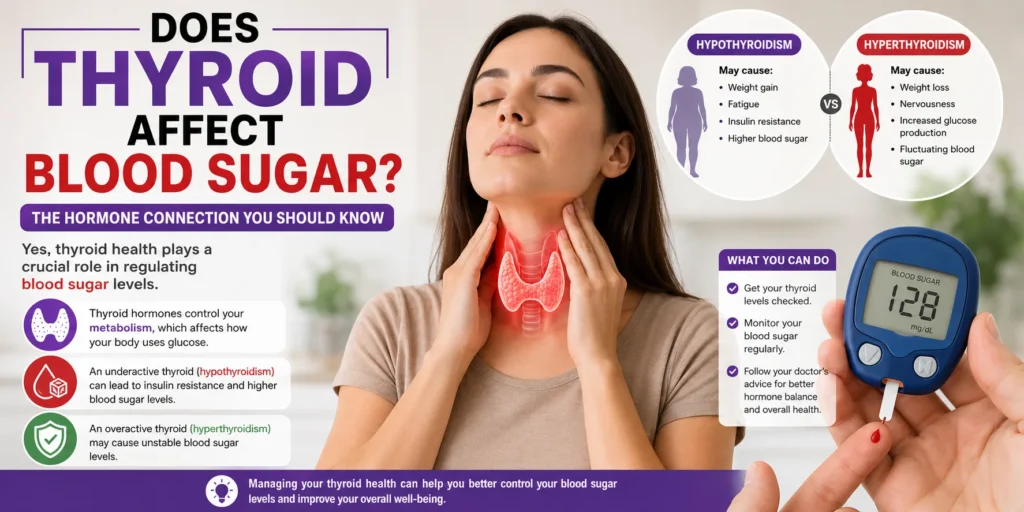
Yes — thyroid dysfunction and blood sugar regulation are closely linked, and this connection is more important than many people realise.
Thyroid hormones play a direct role in how your body metabolises carbohydrates and manages insulin sensitivity.
Hypothyroidism and Blood Sugar
When the thyroid is underactive (hypothyroidism), metabolism slows. This can lead to:
- Increased insulin resistance, which means cells respond less efficiently to insulin
- Higher fasting glucose levels in some individuals
- Increased risk of type 2 diabetes over time, particularly in those with autoimmune hypothyroidism (Hashimoto’s)
- Delayed gastric emptying, which can cause unpredictable glucose spikes after meals
Hyperthyroidism and Blood Sugar
When the thyroid is overactive (hyperthyroidism), the opposite tends to occur:
- Faster glucose absorption from the gut
- Increased glucose production by the liver
- Higher insulin requirements in people with existing diabetes
- Risk of hypoglycemia (low blood sugar) in people on insulin, as thyroid treatment normalises metabolism
Studies published in journals such as the Journal of Clinical Endocrinology & Metabolism have confirmed a bidirectional relationship between thyroid disorders and diabetes. People with diabetes are more likely to have thyroid dysfunction, and people with thyroid disorders have an elevated risk of developing blood sugar abnormalities.
If you have both thyroid disease and diabetes or pre-diabetes, your doctors need to coordinate your care carefully — changes in thyroid function can significantly affect blood sugar control and medication requirements.
Thyroid Cancer and Blood Tests
Thyroid cancer is diagnosed in over 40,000 people annually in the United States alone, making it one of the most common endocrine cancers. Blood tests play an important but limited role in thyroid cancer detection and monitoring.
Can Blood Tests Detect Thyroid Cancer?
Standard thyroid function tests (TSH, T3, T4) cannot diagnose thyroid cancer directly. Most people with thyroid cancer have completely normal thyroid function tests. Thyroid cancer diagnosis requires:
- Ultrasound imaging of the thyroid
- Fine needle aspiration biopsy (FNAB) of suspicious nodules
- Genetic testing in some cases
Thyroglobulin (Tg) as a Cancer Marker
After treatment for differentiated thyroid cancers (papillary or follicular), thyroglobulin becomes a critical monitoring marker. In a patient who has had their thyroid removed (thyroidectomy), thyroglobulin levels should be near zero. Rising levels can indicate cancer recurrence.
- Thyroglobulin testing is also paired with anti-thyroglobulin antibody (TgAb) testing, as these antibodies can interfere with and falsely lower Tg measurements.
- Some patients have TgAb antibodies that make thyroglobulin testing less reliable; in those cases, imaging and other tools are used.
Calcitonin and Medullary Thyroid Cancer
For medullary thyroid cancer (MTC), which arises from the parafollicular C cells of the thyroid rather than the follicular cells, calcitonin is the primary blood marker. Elevated calcitonin levels can indicate MTC. It may also be measured as part of a screening workup if MTC is suspected.
If you have been diagnosed with thyroid cancer or are being monitored after treatment, your oncologist or endocrinologist will specify exactly which blood markers to test and how often.
Can Thyroid Cause High Blood Pressure?
Absolutely — and this is an underappreciated connection that affects millions of people.
Both hypothyroidism and hyperthyroidism can directly influence blood pressure, though through different mechanisms.
Hypothyroidism and Blood Pressure
An underactive thyroid often leads to diastolic hypertension — an increase in the lower number of the blood pressure reading. This happens because:
- Thyroid hormones normally help maintain the elasticity and relaxation of blood vessel walls. Without adequate thyroid hormone, blood vessels become stiffer.
- The heart beats more slowly, and blood vessels narrow slightly to maintain cardiac output.
- Reduced kidney function (due to low thyroid hormone) can cause fluid retention, increasing blood pressure.
Research suggests that subclinical hypothyroidism (mildly elevated TSH with normal T4) may also elevate cardiovascular risk through blood pressure effects, even before obvious symptoms appear.
Hyperthyroidism and Blood Pressure
An overactive thyroid is associated with systolic hypertension — an elevation in the upper blood pressure number. This is because:
- Excess thyroid hormone increases heart rate and the force of each heartbeat
- Blood vessels dilate more, but the increased cardiac output overwhelms this effect
- The resulting high-output state can elevate systolic pressure
Hyperthyroid patients often present with a fast, forceful pulse and elevated systolic blood pressure — a combination sometimes confused with primary hypertension until thyroid function is tested.
The good news: In many patients, treating the underlying thyroid disorder significantly improves or normalises blood pressure. This is why a thyroid test is sometimes recommended as part of a hypertension workup, especially when blood pressure is difficult to control or accompanies other thyroid symptoms.
Frequently Asked Questions (FAQ)
Q1: Is fasting required for T3 T4 TSH test?
A: No, fasting is generally not required for TSH, T3, and T4 thyroid tests. These hormones are not significantly affected by food intake. However, if your thyroid test is being run alongside other fasting tests (like glucose or cholesterol), you may be asked to fast for those other markers. Always check with your specific lab or doctor.
Q2: Thyroid test empty stomach or not — which is better?
A: While not strictly required, many endocrinologists prefer that thyroid tests — especially TSH — be done in a fasted state in the early morning. This reduces variability caused by circadian rhythm shifts and is consistent with how reference ranges are established. If you want the most accurate, comparable readings over time, early morning and fasted is the ideal approach.
Q3: What is the best time for a thyroid test?
A: The best time for a thyroid blood test is early morning, between 7 AM and 10 AM. TSH levels are naturally highest during this window, which makes it the most sensitive time to catch abnormalities. It also ensures consistency if you are monitoring your levels over multiple appointments.
Q4: How many hours fasting is required for thyroid test?
A: Strictly speaking, fasting is not a standard requirement for thyroid tests. But if your doctor or lab recommends fasting — for example, because it is part of a combined panel — a standard fast of 8 to 12 hours (no food or caloric drinks, water is fine) is typically what is meant. If you are unsure, confirm with your lab what their specific protocol is.
Q5: Is fasting required for T3 T4 TSH test? (Reddit / Community Consensus)
A: This comes up frequently in health communities online, and the consensus among users who have discussed it with their endocrinologists aligns with medical guidance: fasting is not required for TSH, T3, or T4 tests. Most users report being told by their doctors that they can eat normally. The exception mentioned most often is when biotin supplements are involved — multiple community members note that they were asked to stop biotin 48-72 hours before the test. Always confirm with your own healthcare provider.
Q6: Should I take thyroid medication before a thyroid blood test?
A: For most patients on levothyroxine (T4 medication), the standard advice is do not take your morning dose before the blood draw. Take it after your test. This prevents a temporary spike in T4 that would falsely elevate your Free T4 reading. For T3 medications or combination pills, consult your prescribing doctor for specific guidance, as the timing considerations are different.
Q7: Do you need to fast for a Free T4 (FT4) blood test?
A: No, fasting is not required specifically for a Free T4 test. FT4 levels are not significantly influenced by whether you have eaten. The more important consideration for FT4 accuracy is whether you have taken your thyroid medication that morning — holding your levothyroxine dose until after the blood draw will give a more accurate reading of your true steady-state T4 level.
Case Study: Getting Accurate Thyroid Results — Isabella’s Story
This is a composite case study based on common clinical scenarios. It does not represent a specific individual.
Background: Isabella, a 34-year-old marketing professional from Delhi, had been struggling with fatigue, weight gain, and irregular periods for about a year. Her general physician ordered a thyroid panel. Isabella took her levothyroxine (prescribed by a private doctor she had seen previously) with her breakfast at 8 AM, then went to the lab at 10 AM.
What happened: Her Free T4 came back elevated, suggesting her dose might be too high — but her TSH was also slightly elevated, which seemed contradictory. Her doctor was confused by the conflicting results.
The problem: Because Isabella had taken her levothyroxine just two hours before the blood draw, her Free T4 was showing the post-dose spike — a temporarily inflated value, not her true baseline level.
Resolution: Isabella repeated the test two weeks later. This time, she held her morning dose until after the blood draw, tested at 8:30 AM, and had not taken any biotin supplements for 72 hours (she had been taking a hair supplement). Her TSH came back at 4.2 mIU/L and her Free T4 was at the lower end of normal — confirming mild hypothyroidism that was not yet fully controlled.
Lesson: The way you prepare for a thyroid test matters. Medication timing, the time of day you test, and supplement use can all affect results. Getting a false or misleading result can delay correct diagnosis and treatment.
Tips for Getting the Most Accurate Thyroid Test Results
- Test in the early morning — ideally between 7 AM and 10 AM
- Hold your levothyroxine until after the blood draw if you are on T4 medication
- Stop biotin supplements at least 48 to 72 hours before testing
- Drink water freely — water does not affect thyroid hormone levels and staying hydrated makes blood draws easier
- Be consistent — if you are tracking levels over time, try to test at the same time of day, at the same lab, using the same method
- Inform the lab about all supplements and medications — some (like high-dose biotin, certain antibiotics, and lithium) can interfere with results
- Do not over-exercise the morning of the test — intense exercise can temporarily alter certain hormone levels
- Manage stress — acute psychological stress can affect TSH levels; if you had an extremely stressful night, mention it to your doctor
Related Conditions to Know
Hashimoto’s Thyroiditis: The most common cause of hypothyroidism in developed countries. An autoimmune condition where the immune system attacks the thyroid. Diagnosed with TPO and TgAb antibody tests. Often associated with blood sugar dysregulation.
Graves’ Disease: An autoimmune cause of hyperthyroidism. Associated with elevated TSH receptor antibodies (TRAb). Can cause significant cardiovascular effects including high blood pressure and fast heart rate.
Subclinical Hypothyroidism: Mildly elevated TSH with normal T4. May not cause obvious symptoms but is associated with modest cardiovascular risk and blood pressure changes. Treatment decisions depend on TSH level, symptoms, and other individual factors.
Thyroid Nodules: Very common (found in up to 50% of adults on imaging). Most are benign. Blood tests alone cannot characterise nodules — ultrasound and sometimes biopsy are needed.
References and Sources
- Bolk, N., et al. (2010). “Effects of Evening vs Morning Levothyroxine Intake: A Randomized Double-blind Crossover Trial.” Archives of Internal Medicine. https://jamanetwork.com/journals/jamainternalmedicine/fullarticle/226082
- American Thyroid Association (ATA). “Thyroid Function Tests.” https://www.thyroid.org/thyroid-function-tests/
- Vanderpump, M.P. (2011). “The Epidemiology of Thyroid Disease.” British Medical Bulletin. https://academic.oup.com/bmb/article/99/1/39/298307
- Duntas, L.H., & Orgiazzi, J. (2019). “Thyroid hormone and cardiovascular disease.” Best Practice & Research in Clinical Endocrinology & Metabolism. https://www.sciencedirect.com/science/article/pii/S1521690X19300563
- Hage, M., et al. (2011). “Thyroid Disorders and Diabetes Mellitus.” Journal of Thyroid Research. https://doi.org/10.4061/2011/439463
- Haugen, B.R., et al. (2016). “2015 American Thyroid Association Management Guidelines for Adult Patients with Thyroid Nodules and Differentiated Thyroid Cancer.” Thyroid. https://www.liebertpub.com/doi/10.1089/thy.2015.0020
- Surks, M.I., & Sievert, R. (1995). “Drugs and thyroid function.” New England Journal of Medicine. https://www.nejm.org/doi/full/10.1056/NEJM199511023331805
- National Institute of Diabetes and Digestive and Kidney Diseases (NIDDK). “Thyroid Tests.” https://www.niddk.nih.gov/health-information/diagnostic-tests/thyroid
- British Thyroid Foundation. “Thyroid blood tests.” https://www.btf-thyroid.org/thyroid-blood-tests
- Cleveland Clinic. “Thyroid Blood Tests.” https://my.clevelandclinic.org/health/diagnostics/4582-thyroid-blood-tests
Disclaimer
The information provided in this article is for educational and informational purposes only and is not intended as a substitute for professional medical advice, diagnosis, or treatment. Always seek the guidance of your qualified healthcare provider with any questions you may have regarding a medical condition, laboratory tests, or medications. Never disregard professional medical advice or delay in seeking it because of something you have read in this article. Thyroid conditions, blood pressure, blood sugar disorders, and thyroid cancer are serious medical matters that require individualised evaluation and management by a licensed physician or specialist.
Read More: Discover expert health tips and trusted wellness advice.

Other Articles